Saturday, August 18, 2012

Mt. Yotei Hike

Summer is the month for camping or other outdoor activities in Hokkaido. 
As usual, we rented a car for a camping trip. But for this time, the main goal is hiking! 
The targeted mountain is not some ordinary mountain, but the so-called Mount Fuji of Hokkaido - because this Mt. Yotei resembles the famous Mount Fuji. 

I initially planned to rent a van for seven of us, but due to Obon holiday season in Japan, most cars were already reserved by others. The only car left was quite a luxurious one - an eight-seater Nisan. It's very pricey! Cost us 32,130yen for 48 hours. 


We began at the base of Kyogoku Route. (There are four different routes to follow for Mt. Yotei hike, but we opted for this one because there are hot spring facility, a convenient store, and a campsite for us to stay overnight near the base)
We talked, we made jokes... This was how we hiked the mountain! ... at least while at the beginning... 


This was the second milestone (as according to the signboard). There are nine in total before you reach the top.
Notice that everyone were still with a smiling face at this point :)

The third milestone.

Here, we started to see clouds in the surrounding just like the morning mist.  


The forth milestone, no one smile anymore... Even if someone does, it didn't seems natural...

The hiking keeps on... which milestone was this? Why someone was blocking the signboard? Okay, who care, lets take a snap and keep going... "pai rew rew"

This particular stone seems so much like the one you will see in a Chinese ink painting.

Again, which milestone was this? or probably we just decided to take a rest somewhere in between. And I don't care anymore that guy in a black shirt wasn't even ready for the picture. Lets snap a pic and more on!
The decision of not bringing my 6kg DSLR gears prove to be a very wise decision! A smartphone with a good camera is all a poor hiker needs!  

From the eighth or ninth milestone onward, the ground becomes very stony. 

Hiking on the stony ground isn't easy, because the stones can easily sliding against each other and causing you to slip. So there is a rope for you to hold while passing through this area.  


After the stony route, you will reach a plateau and see this signboard. Turning left is going towards the top of this bloody hell Mt. Yotei :)

Almost there, but this is a good spot to take photo too. So why not... 


Finally, the top of Mt. Yotei!
 

Actually, Mt. Yotei is an active volcano just like its big brother Mt. Fuji. You can see its crater in the next two photos. 


There are some short plants at the plateau of Mt. Yotei. 


I have totally no idea what this is... someone's grave?

I took a nap at the plateau (probably 40-60min) before we went down.
The way down... after some rest and a meal for lunch, the smiling face reappeared!

Some wildflower species at Mt. Yotei.


A view of Kyogaku town.

Pink mushroom. Looks very delicious.


From about the half mountain down, I started to walk with a cane. My thighs and the right knee hurts a lot probably because of me jumping too much (from branch to branch like a chimp) at the beginning of the way down. 

Right out of the forest is this resting place with the magnificent scene.
Here Matteo kindly offered a piece of apple to us which, as far as I can remember, it was so refreshing and tasty that it made me forgotten about the pain at my knee and thighs, momentary.

After the hike, we went to the nearby campsite and set up the tent.
Beside the tent is this crystal clear stream...  


The next morning, I brought a chair there to enjoy my breakfast. Superb!!!

Saturday, May 5, 2012

Diffraction vs DOF

Diffraction! it reduces the sharpness and contrast of your image, thus the overall resolution - isn't it scary?
You will have diffraction issue if using a too small F-stop. Few years back when I first learn about it, I started to limit my aperture setting to what could avoid it all together despite any given photography situation. Back then I have two lenses, so I got to test them to know what is the 'too small' value for these lenses:
1. Canon EF 100mm f/2.8 USM Macro and
2. Canon EF 16-35mm f/2.8 L II USM.

I found that the images begin to appear softer at F8 in the former, and F9 in the latter. So I stop shooting beyond these limits.

Today, I have changed my mind about the factors to consider when setting the F-stop.
Yes, deffraction can reduce the overall resolution of the image. But there are more to consider when 'creating' a photo.

At a glance, how these two photos differ to you? Which one do you like more (assuming both of them have the birds on the roof, so those birds are not the deciding factor)?

At small size you can hardly tell any difference isn't it?
Due to diffraction, the one (above) with F22 appears softer, and provides lesser details, especially at the focal plane (the wooden wall facing the viewer). However, it does provide much greater DOF (depth of field).
See the 100% cropped side-by-side comparison and you'll know what I mean:
Focal plane: Left - No diffraction at F8, sharper image and better colour contrast.
Right - At F22, image is softer due to diffraction.

Background: Left - better resolution.
Right - softer image, although not as obvious as at focal plane.

Foreground: Left: DOF is shallow - blurry foreground.
Right: With F22, the DOF extended to the foreground.

After the detailed comparison, what do you think?
For this landscape shot, I preferred the grass in the foreground to be in focus, so I don't mind to sacrifice some loss of resolution at the focal plane.
Btw, if I didn't show the 100% cropped, I doubt anyone will notice the diffraction issue when viewing the smaller picture, which is often the case when we share something on the internet. 

Another situation when I don't mind to have a little diffraction is when I want to create the star effect in night-time photography. To me, the dazzling touch of the star effect in exchange of some lose of resolution at the focal plane is definitely worth it.
F5 (above) and F16 (below).

100% cropped: F5.6 (left) and F16 (right).

100% cropped: F8 (left) and F16 (right).

The star effect starts to show at F5.6, but even at F8.0, it is still too weak to make an impact to me. I personally like to use F16, which create a big-enough star effect while the image didn't suffer so much from diffraction issue.
Perhaps a better example to illustrate the impact of star effect in night-time photography is through a picture with bigger light sources - didn't the starry street lights catch your eyes?
F16; 6s; ISO160


Monday, March 12, 2012

Winter 2012 - Photography Trip

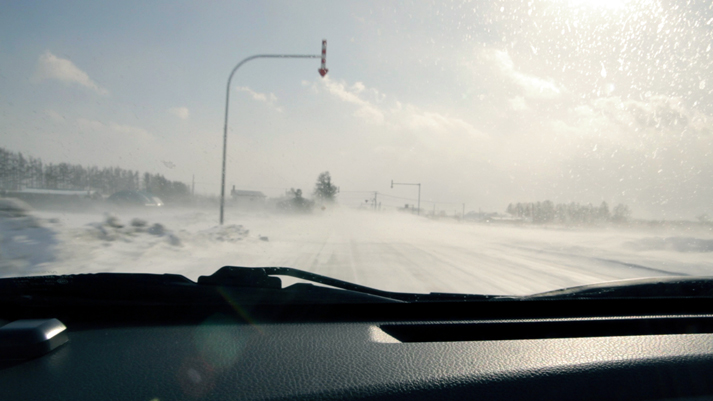
This winter has been very fruitful for my photography. After so many years staying here, I finally rented a car in winter and driven around on icy roads, with occasional snowstorm and white-out (with Ankit, an Indian friend who is on his way picking up photography, and Hannes, a German friend who called for the trip). 
Visibility in snowstorm  
Almost white-out
Entering tunnel
Exiting tunnel
In windy condition, if the road is level with an open field,
there will be continues sheets of snow hurtling across the road
At night, when snowing, driving with high light is impossible.
I put on the high light for few sec just for the sake of photography.
As I am driving, so Ankit took the shot. 


For the trip, the final destination is Sounkyo, a small town  at the middle-north of Hokkaido with average temperature 5C colder than Sapporo. 
The first stop was at a hot-spring resorts area (Shirogane town) for taking pictures of this waterfall. The waterfall remained unfrozen because it's a hot spring waterfall. 
You can see the steam rising from the water
Next, we went to a natural hot spring at middle of a mountain. It's really in the wilderness! The surrounding temperature was -5C while the water was 46C... a very extreme hot-spring experience.   

When we left the hot spring, it's already dark. From Shirogane to Sounkyo took us about three hours on icy road. 
Sounkyo is located in mountainous area with many elevated cliffs. When in autumn, the cliffs turn colorful and this is why Sounkyo is listed as one of the popular red-leaves viewing spot of Hokkaido. 
The white-vertical area at the left is frozen waterfall
Taken from Mt. Kurodake. When doing time lapse, the battery  of my timer control  went dead  because of the cold temperature - first time experiencing this.


I have also visited a ski resort for the very first time not doing any snowboarding, but just photography. 
The panorama photo was taken from Mt. East of Rusutsu ski resort. I chosen this resort because of the Mt. Yotei view.
My Canon 16-35 mm lens safe my day.
Without the 16 mm wide angle,
I will not achieve a shot with this perspective
 which gives emphasis on the snow accumulated on the trunk,
and it will make a less impact then.  

The following shots seem like the desert, but with snow instead of sand?
Maybe I have not travel to other places and therefore I have yet find other places with this kind of scenery except on top of the ski mountain.  


Thursday, December 22, 2011

Elephant never forget!

Elephant never forget!
And that is why it was chosen for the icon of a note-taking software, the  Evernote.
I think I am safe to say that elephants do forget eventually, just that they have a much superior memory as compared to other animals. Anyway, before I gone too far into animal facts, lets get back to the main subject of this post.
I begin to use Evernote few weeks ago for note taking (mostly for information from the internet), saving website addresses (in place of bookmarking which only accessible through the computer you bookmarked them - very frustrating sometime), and making to-do list. One very convenient feature about Evernote is that it provide you with an account. Once logged in, you can synchronize your notes created from different computers (in my case, between the one at home and at the office). So you can access your notes, whenever and wherever, for as long as you have access to the internet. Hmm how can we live without the internet if more and more things like this get into our life?

When I started it, my initial plan wasn't actually to get a note taking software. I was figuring how to make a To-Do check list along with the Google Calender (GC). As you know (if you are a GC user) the GC only reminds us about the upcoming events. So, how about the things needed to be done? Depends on your mum? or your wife? Of cause they are often kind enough to keep 'reminding' you about the things you needed to do, by telling you when to eat, when to take both, etc... but... you know what I mean. We are talking about the To-Do list, not those to-do list (although I must agree that they are important too, in fact, the most vital things to do in life)... okay, lets get back to the main track of the post.

As I am looking for a way to create a To-Do list along side the GC, I found that GC has a feature which allows us to add gadget in it. One of the gadget is the Evernote gadget. (to learn how http://www.vikitech.com/563/easily-add-evernote-gadget-to-your-gmail-and-google-calendar)   
Once I added the Evernote in my GC, now I can keep track of my to-do list which I created in the Evernote program. Their combination is a perfect solution for people like me who has bad memory!
Now, as long as I can access the internet, and provided that I didn't forget my Evernote log in identity, I'll have the superb memory just like elephant :)


Monday, December 5, 2011

Persimmon (柿子)

I still remember that when I was little, I once asked my mum "why you never bought the new-year fruit?" after I saw persimmon in our neighbor's house. Back then I don't know the name of the fruit and so I called it new-year fruit because it is available when near the Chinese New Year. My mum said it is too expensive when compared to other common fruits like apple or orange. So it worth more to have two apples or oranges than only one persimmon for the same price.
Perhaps my mum has planted in me the thought that I should go for persimmon when the price is comparable to  other fruits. Of cause, we should never overlook the influence parents could have on their children. Even for some small matter which we don't think it may bother anyone, but it could still have the potential to shape the way the children perceive the world, even in their later life.

In Japan, the season of persimmon is around the end of autumn. And that is when the Jusco near the dormitory we are staying starts to sell the fruit in a large quantity with very affordable price. 99 yen each to be precise. The conversion rate to RM of cause will make it seems expensive. But when considering the salary of Japanese, it is like RM1 each.
Btw, by far I am referring to the smaller specie one shown in the photo. As for the larger one, I've never seen it at Jusco. It's a souvenir my wife received from her colleague who recently went outstation and bought it at the place of the business trip. According to her colleague, the fruit isn't available else where. So this is a very rare opportunity to taste such a big persimmon.
As you may see, it is about the size of a big apple. But what really make it so irresistible to me are the sweet taste and the crunchy bite. By 'and' I really mean it like in a math's definition - the two conditions 'sweet' and 'crunchy' must be present for the 'irresistible' to be true. We can easily find a sweet persimmon even among the the smaller specie one, but the bite never feel like the apple-liked crunch. It is only with the big persimmon that I learnt that the fruit can be crunchy as well. And to me, the crunchy feeling is way better than the Apple's one because the hardness is just nice.